End the Senate filibuster
41 senators representing 24.5% of Americans can block a bill 59 senators support.
The filibuster lets a small minority of an already lopsided Senate decide whether the majority gets to vote at all. Here is the math for the Senate that takes office in January 2027.
The 2027 U.S. Senate
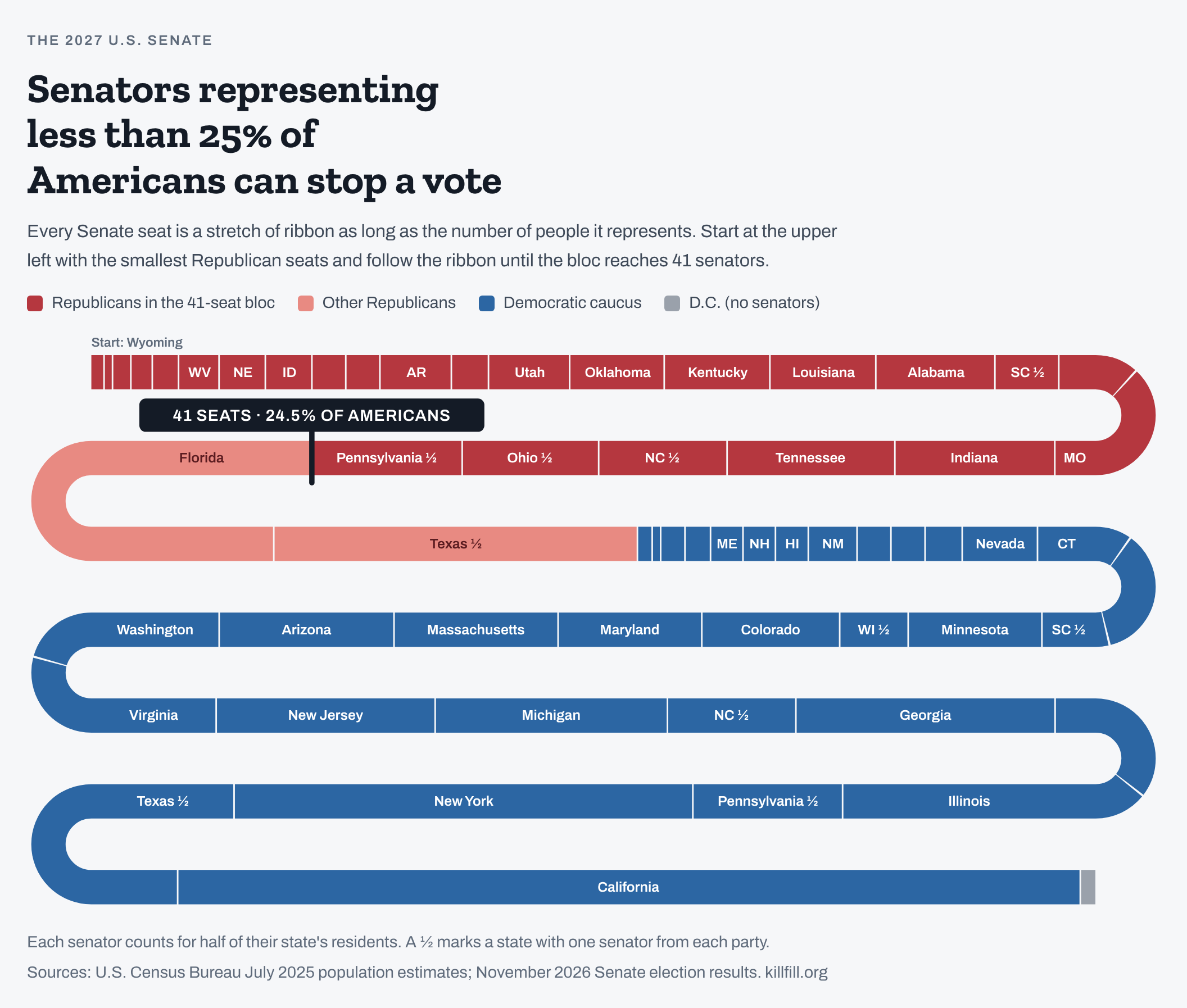
Senators representing less than 25% of Americans can stop a vote
Every Senate seat is a stretch of ribbon as long as the number of people it represents. Start at the upper left with the smallest Republican seats and follow the ribbon until the bloc reaches 41 senators.
- Republicans in the 41-seat bloc
- Other Republicans
- Democratic caucus
- D.C. (no senators)
Why 59 votes isn't enough
Under Senate Rule XXII, ending debate on most bills takes 60 votes. That vote is called cloture. If 41 senators refuse, debate never formally ends, and the bill never gets a final up-or-down vote.
So a bill can pass the House, win the support of 59 senators, and still die without a single vote on the bill itself. Nobody has to defend voting against it, and the president never has to decide whether to sign it.
A small-state veto on top of a small-state Senate
The Senate already gives Wyoming and California two senators each, though California has about 67 times as many residents. The 20 smallest states have 34.8 million people combined, fewer than California's 39.4 million, and they hold 40 seats.
The filibuster compounds that imbalance. It hands a minority of this already unequal chamber the power to decide whether the majority can vote at all.
Right now that tilt runs hard against Democrats, because Republicans hold so many of the least populous states. In the 2027 Senate:
The principle doesn't depend on which party benefits. A rule that lets senators representing a quarter of the country stop the rest would be just as wrong if it ran the other way. Whichever party wins the majority should be able to bring its bills to a vote and answer to voters for what it passes.
The filibuster used to be rare
The 60-vote Senate is a recent habit. Cloture motions, filed to end a filibuster, are the standard way to measure how often it is used. From 1917 through 1970, senators filed 58 in total. In 2025 and 2026 they filed 306.
Cloture motions filed in each Congress, 1917 to 2026
What ending it would change
Imagine the House passes a bill and 59 senators are ready to move it forward. Without the filibuster, voters would see how every senator votes on the bill itself. If it passes, the president has to sign it or veto it, in public, and voters know who decided.
The minority would still have time to debate, offer amendments and make its case. Then the Senate would vote. The party that wins a majority gets the power to pass its agenda and the responsibility to defend it at the next election. That should hold the next time Republicans win the Senate, too.
Show the math
Each senator is assigned half of their state's residents, since two senators share a state. We sorted the 44 Republican seats from fewest to most residents per seat and added them up until we reached 41. Those seats cover 83.8 million people, or 24.5% of the 341.8 million U.S. residents (including D.C.).
Counting each state's full population once, even when only one of its senators is in the bloc, gives a larger figure: 41 Republican senators from 24 states home to 32.5% of Americans. Either way, it's a minority. Philip Bump used the same half-state method for the Washington Post in 2021.